You spotted a listing, ran the math on the per-square-foot rate and figured you'd nailed down your warehouse rental cost in Austin. That number was probably never the full story. Many warehouse listings quote only the base rent, while property taxes, insurance and maintenance tend to surface later — often as a surprise on your first invoice.
Once you understand how those costs translate into your actual monthly rate, you can gain real leverage. You can compare listings accurately, catch red flags before you sign and negotiate from a position of strength instead of playing catch-up. Discover everything you need to know about warehouse rental costs as a small company in Austin.
Austin Warehouse Space Pricing
Overall asking rent for warehouse space in Austin may fluctuate based on market conditions. Costs may also vary according to factors like the square footage, the type of space you need and where in the metro you're searching.
Warehouse Rentals by Property Type
The type of industrial space you choose directly affects your rate, since each property type offers a different level of build-out and functionality.
- Warehouse and distribution space: Built for storage and logistics rather than specialized infrastructure, this is typically the most budget-friendly category on the market.
- Flex-industrial and office-service space: This blend of warehouse and office space commands a higher rate because of the added build-out, climate control and office-grade finishes.
- Manufacturing space: Pricing here varies widely based on existing infrastructure. A bare shell costs less than a space with power, ventilation or specialized equipment already in place.
How Location Within Austin Affects Your Rate
Where your space sits inside the Austin metro matters just as much as the type of space you choose. Here's why:
- Proximity to the urban core: Space located closer to central Austin typically carries a premium, since land is scarcer and harder to develop the closer you get to the city center.
- Local supply and demand: Submarkets with less available inventory tend to push rates higher, while areas with more vacant space available give tenants more room to negotiate.
- Access to highways and labor: Locations near major highway corridors and larger labor pools tend to attract greater demand, which can push prices upward compared to harder-to-reach areas.
Submarkets closer to the city center tend to reflect these pressures most, while areas farther out often balance newer construction with longer commutes for your workforce and customers.
What Is NNN, and Why Will Your Real Bill Be Higher?
Most warehouse listings across Austin are quoted NNN, and most first-time tenants don't learn what that actually includes until their first bill arrives.
What NNN Fees Actually Include
NNN stands for triple net lease, meaning the rent you see listed is only the starting point. On top of that base rent, you may also be responsible for other expenses, including:
- A share of the property's taxes
- Insurance fees
- Common area maintenance — often shortened to CAM
Utilities are typically metered separately and billed straight to you, while internet, janitorial service and equipment aren't included at all. Understanding these add-on costs up front is one of the most important steps a small business owner can take before signing a lease.
Calculating Your True Monthly Cost
Once you know what NNN includes, the concept becomes simple, even if the final number takes some digging to pin down. Your true monthly cost can be calculated by adding your base rent rate to your operating expenses, multiplying that number by your square footage and dividing by 12.
Operating expenses vary depending on the age and condition of the property, the scope of the landlord's maintenance program and how property taxes are assessed in that particular area. Most leases also build in an annual rent escalation, a scheduled increase applied at regular intervals. The exact terms vary by landlord, so it's worth asking up front rather than assuming your rate will hold steady for the life of your lease.
Other Up-Front Costs to Budget For
Beyond your monthly NNN payment, a few other costs deserve to be considered in your budget:
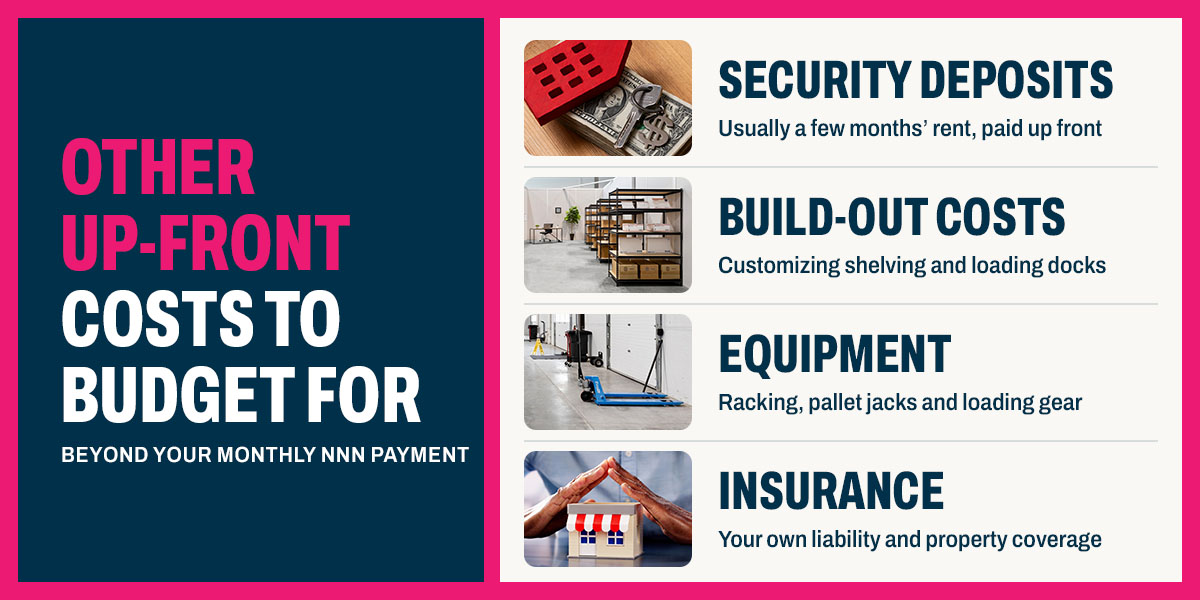
- Security deposits: Most landlords require an up-front deposit, typically equal to a few months' rent, before handing over the keys.
- Build-out costs: Customizing a space, from shelving to loading dock upgrades, is typically your responsibility and expense.
- Equipment: You'll usually need to supply your own racking, pallet jacks and other loading gear under a standard NNN lease.
- Insurance: Most leases require tenants to carry their own liability and property insurance, separate from the building's policy.
What Small Businesses Should Look for in a Warehouse Space
With a clearer picture of what drives your cost, you're ready to evaluate space with a sharper eye. Three factors matter most for small businesses and e-commerce operators sizing up their options.
- Right-sizing your space: Traditional industrial leases often require a long-term commitment, which can lock you into a footprint before you know how much space your business needs.
- Lease flexibility: A multiyear commitment carries real risk for a growing business. In markets with more available inventory, landlords tend to be more open to shorter, more flexible lease terms that recognize businesses can't always predict their space needs years out.
- All-inclusive vs. NNN pricing: Always run the full math before comparing offers. A higher all-inclusive rate that bundles utilities, equipment and services can end up cheaper than a lower NNN rate once every add-on gets totaled up.
Find a Smarter Way to Rent Warehouse Space With Portal Warehousing
Portal Warehousing is opening a new location in Austin in early 2027, bringing a new approach to warehouse space for the city's small-business community. Instead of piecing together NNN math, Portal's warehouse spaces run on one predictable monthly bill, covering utilities, Wi-Fi, loading docks, daily pickups from major carriers and building security.
Our units range from 250 to 4,000 square feet and start at $995 a month, so you only pay for the space you need today. Lease terms run 3, 6 or 12 months, giving you Portal's all-inclusive monthly pricing without locking into years you can't predict. Our members also benefit from access to coworking offices, conference rooms and a network of fellow entrepreneurs navigating the same growth questions you are.
If you're weighing traditional vs. flexible warehousing for the first time, Portal Warehousing was designed around how small businesses actually operate. For e-commerce operators, Portal's flexible e-commerce warehousing solutions pair daily carrier pickups with the fulfillment infrastructure fast-moving sellers need.
Book a Tour With Portal Warehousing Today
If you're ready to learn more about our options, book a tour today and join Portal. More than a warehouse.